
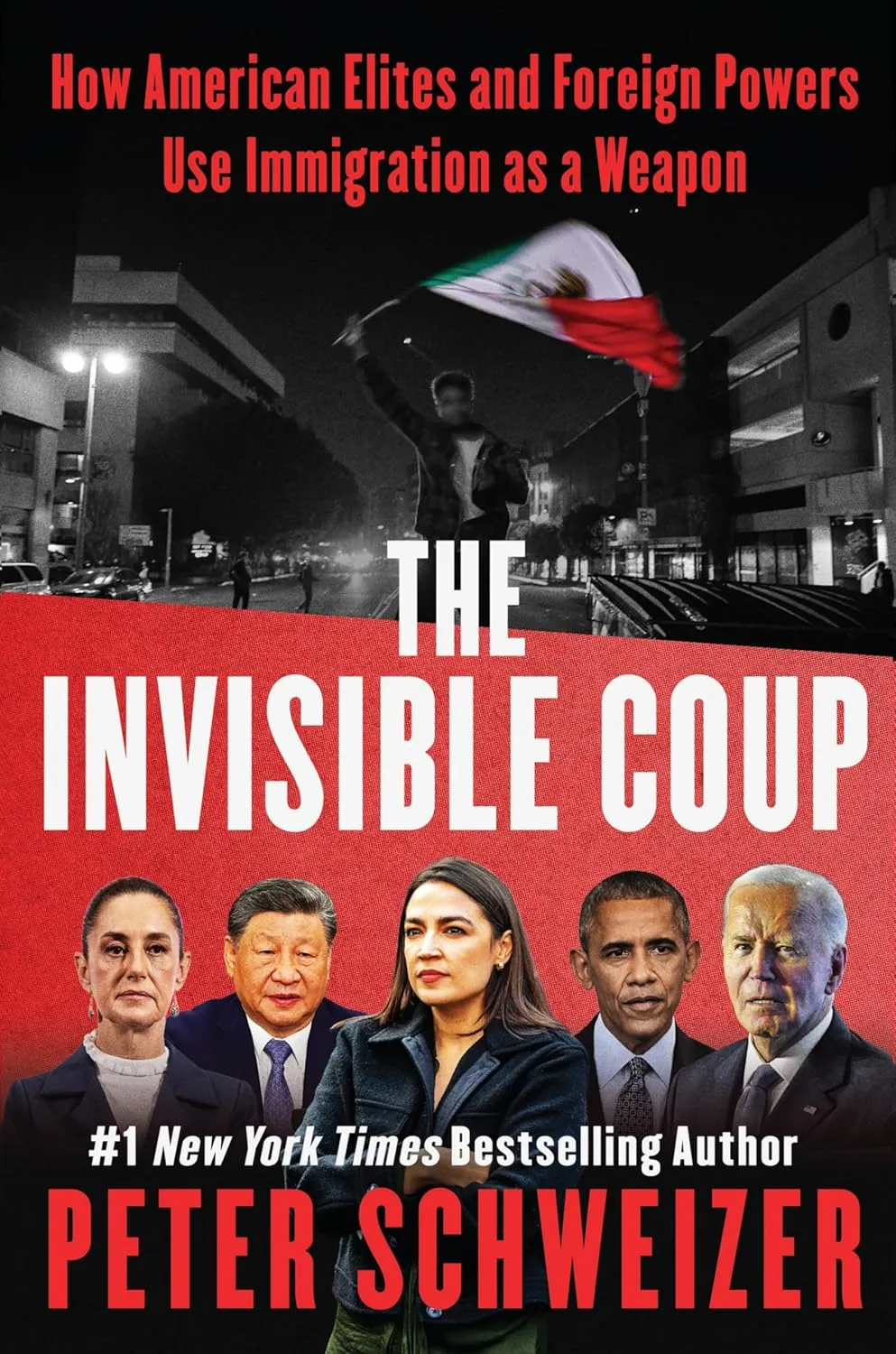
“They didn’t just come here. They were sent here.”
📖 Overview
The Invisible Coup: How American Elites and Foreign Powers Use Immigration as a Weapon is the latest investigative bombshell from Peter Schweizer, published on January 20, 2026 by Harper. An instant #1 New York Times bestseller — holding that position for three consecutive weeks — it is Schweizer’s most ambitious and controversial work to date.
The book’s central argument is that mass migration into the United States is no longer primarily a humanitarian or economic phenomenon. Schweizer contends it has been deliberately engineered as a geopolitical weapon — orchestrated by a coalition of domestic elites (political figures, establishment NGOs, and major philanthropic foundations) working in alignment — whether knowingly or not — with foreign adversaries including China, Mexican drug cartels, and radical political movements in Latin America.
Backed by two years of forensic fieldwork conducted by a team of investigators at the Government Accountability Institute (GAI), and drawing on confidential documents, intercepted communications, and money flow analysis, Schweizer argues that what most Americans see as a border management problem is in fact a coordinated assault on U.S. sovereignty, national security, and democratic stability — one operating below the threshold of conventional warfare.
The book has already influenced the national political conversation and, according to Schweizer, is being considered for use in a Supreme Court case on birthright citizenship by the Trump administration.
⚡ Key Takeaways
| # | Key Takeaway | Why It Matters |
|---|---|---|
| 1 | Mass migration is being used as a weapon | Schweizer reframes immigration as a national security issue, not merely a political or humanitarian one |
| 2 | Domestic elites are complicit | Political leaders, NGOs, and foundations funded by Soros and Gates are documented as facilitating the flows |
| 3 | China is exploiting birthright citizenship | A network of surrogacy agencies is placing CCP-connected children inside U.S. borders for long-term strategic gain |
| 4 | Mexican cartels coordinate with the government | Schweizer documents cartel-state linkages and Mexican consulate interference in U.S. elections and policy |
| 5 | The Catholic Church has been drawn in | The book’s most controversial claim links Pope Francis and liberation theology figures to the broader migration apparatus |
| 6 | The coup is “invisible” by design | The strategy avoids kinetic conflict — it operates through policy loopholes, NGO networks, and narrative capture |
| 7 | U.S. government tracks almost none of this | Federal agencies do not record nationality of parents on birth certificates — a systemic blind spot Schweizer documents in detail |
| 8 | Prior Schweizer investigations produced real-world results | His past books sparked FBI probes and bipartisan reforms — this book is already being cited in policy circles |
📚 Book Structure
At 288 pages, The Invisible Coup is structured as a series of interlocking investigative chapters, each focused on a specific actor or mechanism within what Schweizer frames as the larger coordinated strategy. The book builds its case cumulatively — each chapter adding a new layer to the central thesis.
The Framework — Weaponized Migration
Schweizer opens by establishing the conceptual foundation: that the post-WWII humanitarian framing of mass migration has been systematically exploited. He introduces the concept of “non-kinetic warfare” — the use of demographic, economic, and political tools to weaken an adversary without firing a shot — and argues that the United States is currently on the receiving end of exactly this strategy.
The Domestic Network — Elites, NGOs & Foundations
The book’s middle chapters document the domestic infrastructure that enables and accelerates mass migration. Schweizer follows money flows from major philanthropic foundations — specifically organizations connected to George Soros and Bill Gates — through a network of global NGOs and into on-the-ground migration facilitation. Political figures who have received funds from these networks are named and their policy positions mapped.
The China Chapter — Surrogacy, Birthright & the Manchurian Generation
One of the book’s most explosive sections documents a network of over 107 Chinese surrogacy agencies operating in California, used by CCP-connected individuals to obtain U.S. birthright citizenship for their children. Schweizer presents evidence suggesting this is a deliberate long-term strategy — creating a generation of Chinese-born U.S. citizens who may eventually hold positions of influence inside American institutions.
The Cartel-State Chapter — Mexico’s Hidden Hand
Schweizer documents the relationship between Mexican drug cartels and elements of the Mexican state, arguing they function in de facto coordination on migration flows. He also presents evidence of Mexican consulates actively intervening in U.S. domestic politics — an allegation that prompted an official denial from Mexico’s ambassador and Claudia Sheinbaum’s government.
The Church Chapter — Liberation Theology & the Vatican
The book’s most controversial section examines the role of the Catholic Church — specifically the influence of liberation theology (described as a fusion of Marxism and Catholicism) and Pope Francis’s embrace of its adherents. Schweizer concludes that the Church has played a major operational role in the migration apparatus, a claim that has drawn significant pushback.
The Path Forward — Solutions & Policy Implications
Schweizer closes with a forward-looking section outlining what he sees as the necessary policy responses — including a reformed approach to birthright citizenship, NGO accountability, and foreign agent registration enforcement — framing the problem as solvable if the political will exists to confront it.
✍️ About the Author
Peter Schweizer is the president of the Government Accountability Institute (GAI) and a former William J. Casey Fellow at the Hoover Institution, Stanford University. He is a #1 New York Times bestselling author whose previous books include Red-Handed, Blood Money, Secret Empires, Clinton Cash, and Profiles in Corruption — works that have collectively sparked FBI probes, congressional investigations, and bipartisan legislative reforms.
He is a Senior Contributor at Breitbart News and has appeared on Fox News, CBS’s 60 Minutes, and major networks. His books have been translated into eleven languages. He operates from a distinctive methodology: forensic financial investigation by a dedicated research team, followed by publication of findings backed by documentary evidence.
Schweizer is a polarizing figure. His supporters credit him as one of the most consequential investigative journalists in American political life; his critics argue his work is partisan in framing and selective in sourcing. The Invisible Coup represents his most expansive argument to date — and his most controversial.
💡 Why This Book Resonates
The Invisible Coup arrives at a moment of acute national anxiety about immigration, sovereignty, and the reliability of institutions — and it speaks directly to that anxiety with documentary specificity rather than rhetorical generality. For readers who have felt that the immigration debate was missing something — that the scale and persistence of the problem couldn’t be explained by policy failure alone — Schweizer offers a structured counter-narrative.
What separates this book from ideological commentary is its methodology. Schweizer’s team spent two years tracing money flows, obtaining confidential documents, and building evidentiary chains. Whether or not readers ultimately accept all of his conclusions, the investigative architecture forces engagement with specific facts rather than abstractions.
The book also resonates because of its real-world consequences. The Mexican government has publicly responded to its allegations. The Trump administration has reportedly cited the book’s findings in legal preparations for a Supreme Court case on birthright citizenship. Senators have called for investigations based on its revelations. This is not a book that exists only in the media cycle — it is actively shaping policy debates.
For readers across the political spectrum interested in national security, immigration policy, foreign interference, and the mechanics of political influence, The Invisible Coup is required reading — even, or especially, for those who disagree with its conclusions.
⚠️ Editorial note: This is a politically charged work from a conservative investigative journalist. Its claims are contested by several of the entities named — including the Mexican government and organizations linked to Soros and Gates. Readers are encouraged to engage with both the book’s evidence and its critics’ responses for a complete picture.
🎯 Ideal Audience
This book will resonate most strongly with readers in the following categories:
- Readers of Schweizer’s previous work (Blood Money, Red-Handed, Clinton Cash) who follow his investigative methodology
- Conservatives and national security hawks concerned about immigration, foreign interference, and institutional capture
- Policy professionals, lawmakers, and researchers working on immigration, national security, or foreign agent regulation
- Journalists covering immigration, China, Mexico, NGO networks, or the Catholic Church’s political role
- Readers of investigative political nonfiction in the tradition of Bob Woodward, Michael Shellenberger, or Matt Taibbi
- Anyone seeking a documented, evidence-based case for the national security framing of mass migration
- Critical readers who want to understand the strongest version of the conservative argument on immigration
ℹ️ Content note: The book contains no explicit content. It does include detailed discussions of criminal violence, cartel operations, political corruption, and foreign interference. Some claims are disputed by named subjects.
💬 Memorable Quote
“They didn’t just come here. They were sent here.”
This is the book’s defining line — sparse, declarative, and deliberately designed to reorient the entire frame through which the reader understands the immigration debate. It appears in the opening pages and functions as the thesis distilled to its core. Every subsequent chapter is, in effect, the evidentiary case for that single sentence. Whether or not the reader ends the book convinced, this line is the one that stays.
🧵 Central Themes
| Theme | Description | How It Manifests |
|---|---|---|
| Weaponized Migration | Immigration as a tool of geopolitical warfare rather than a humanitarian phenomenon | Documented coordination between foreign actors and domestic NGOs to drive migration flows |
| Elite Complicity | Domestic political and philanthropic elites enabling foreign strategic goals | Money flows traced from Soros/Gates foundations through NGO networks to migration facilitation |
| Chinese Long-Game | Beijing’s multi-decade strategy to embed influence inside U.S. institutions | Surrogacy networks, birthright citizenship exploitation, and the “Manchurian Generation” thesis |
| Cartel-State Nexus | The functional alignment between Mexican drug cartels and elements of the Mexican government | Migration route control, election interference, and consulate political operations |
| Non-Kinetic Warfare | Fourth-generation warfare conducted through demography, policy, and narrative rather than weapons | The “invisible coup” — undermining sovereignty without a single shot fired |
| Institutional Capture | How adversaries and elites have embedded themselves within U.S. civic, religious, and political structures | The Catholic Church chapter; NGO infiltration of federal funding streams |
| Narrative Control | How the “compassion” framing of immigration has been used to suppress legitimate security debate | Schweizer’s critique of media and academic framing of immigration skepticism as bigotry |
| Accountability Gap | The failure of federal agencies to track, measure, or report the phenomena Schweizer documents | No nationality tracking on U.S. birth certificates; unmonitored NGO money flows |
❓ Frequently Asked Questions
Is this book partisan? Is it credible?
Schweizer is a conservative investigative journalist, and the book’s framing reflects that perspective. However, his methodology — forensic financial investigation backed by documentary evidence — is taken seriously even by those who disagree with his conclusions. Previous Schweizer books have triggered FBI probes and bipartisan legislation. Readers should engage the evidence critically while also reading the responses from entities named in the book.
Has the Mexican government responded?
Yes. Both Mexico’s ambassador to the U.S. and President Claudia Sheinbaum publicly denied the book’s allegations of consulate interference in U.S. elections. The Mexican Embassy issued a statement claiming “strict political neutrality.” Schweizer has maintained his documented evidence stands.
What is the “Manchurian Generation” claim?
Schweizer presents evidence that CCP-connected individuals have systematically used U.S. birthright citizenship — via surrogacy agencies in California — to produce American-citizen children who may eventually be positioned in U.S. institutions. He found over 107 such agencies operating in California alone, and notes the federal government keeps no records of parental nationality on U.S. birth certificates.
Why is the Catholic Church chapter considered the most controversial?
Schweizer documents the Church’s role in funding and operating migration facilitation networks, and traces the ideological influence of liberation theology — which he characterizes as Marxist-aligned — on Pope Francis. He concludes that the Church has played a major role in what he calls the greatest subversive act in American history. The claim implicates the Pope directly and has generated significant backlash.
Is the book being used in actual policy?
Yes, according to Schweizer. He has stated that the Trump administration is using the book’s findings on birthright citizenship in preparations for a Supreme Court case. Senators have also called for investigations based on specific revelations in the book.
Do I need to have read Schweizer’s earlier books?
No. The Invisible Coup stands completely on its own. That said, readers familiar with Blood Money and Red-Handed will recognize Schweizer’s investigative approach and will see The Invisible Coup as a natural extension of his China-focused work into the immigration arena.
🌟 Final Thoughts
The Invisible Coup is Peter Schweizer’s most ambitious book — and his most consequential. Whether it ultimately changes minds or reinforces existing ones, it cannot be ignored. Its evidentiary weight, the specificity of its targets, and the real-world responses it has already provoked place it in a category above most political nonfiction.
The book’s core achievement is reframing. By the final page, even a skeptical reader is forced to grapple with a series of documented facts about birthright citizenship, NGO money flows, and cartel-state dynamics that don’t simply disappear because they are inconvenient. The debate about whether Schweizer’s interpretation of those facts is correct is a healthy one — but having the facts in public view matters, regardless of where that debate lands.
For readers who want to understand the national security framing of the immigration debate at its most documented and most detailed, this is the defining text of 2026.
“Urgent, shocking, and overflowing with national-security implications — The Invisible Coup makes America’s greatest political threat visible for all to see.”
🔗 Useful Links
| Resource | Where to Find It |
|---|---|
| Barnes & Noble | barnesandnoble.com — Hardcover & Paperback |
| Official Book Site | theinvisiblecoup.com — ongoing reports & exclusives |
| Government Accountability Institute | g-a-i.org — Schweizer’s research organization |
| Publisher (Harper) | harpercollins.com |
| BooksBriefed.com | More Summaries |