“A biting, subversive thriller about what happens when women finally choose to take justice into their own hands — with killer results.”
📖 Overview
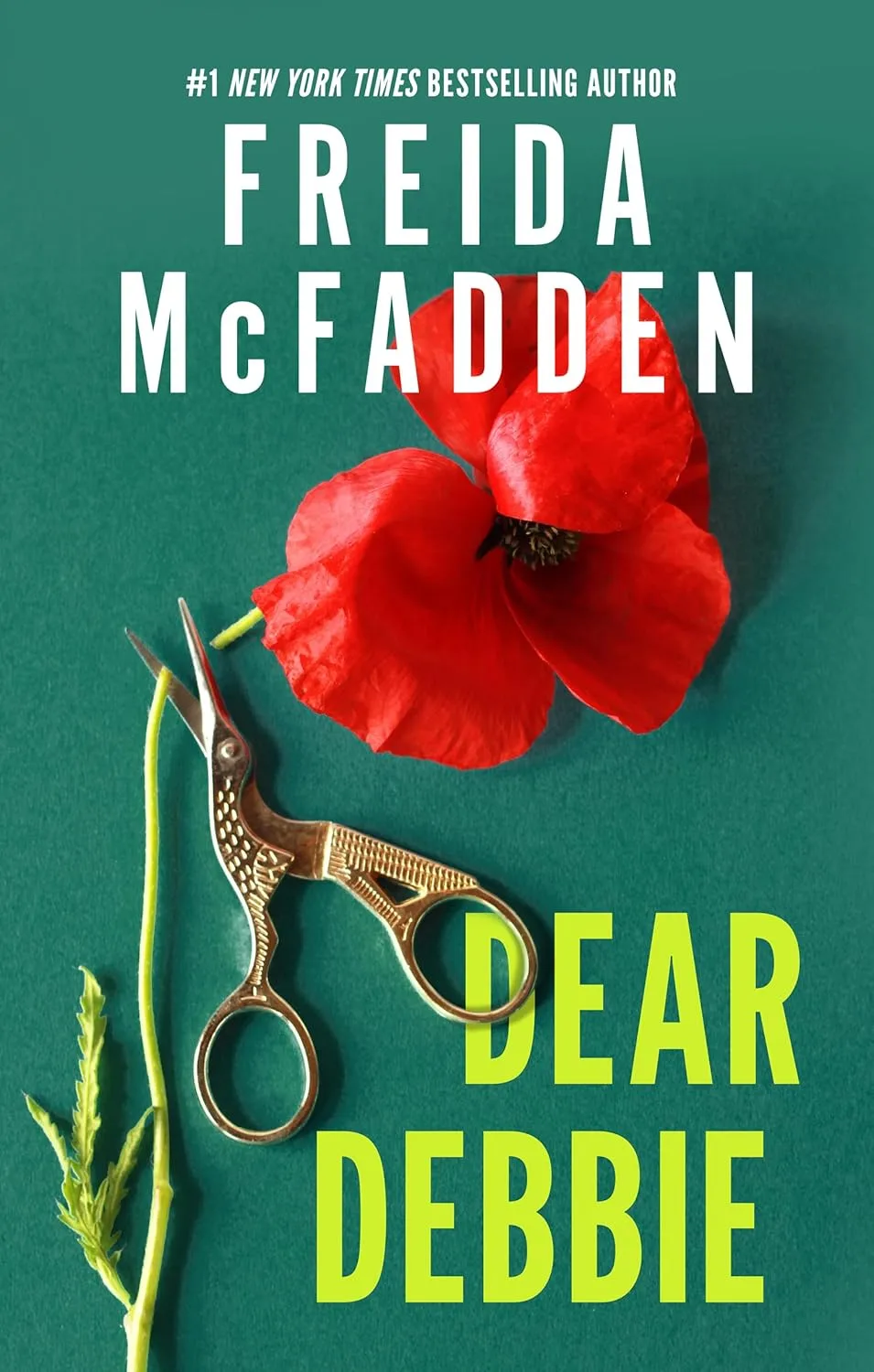
Dear Debbie is the latest psychological thriller from Freida McFadden — #1 New York Times, USA Today, Wall Street Journal, and internationally bestselling author of The Housemaid. Published on January 27, 2026 by Poisoned Pen Press, it marks McFadden’s return with a wickedly sharp, darkly comedic revenge story that has already become one of the most talked-about thrillers of 2026.
The novel centers on Debbie Mullen, a suburban advice columnist in New England whose carefully constructed life begins to unravel — and who decides, for the first time, to start taking her own advice. What follows is a gleefully unhinged spiral of payback, secrets, and suburban chaos narrated through the eyes of one of fiction’s most compelling new antiheroes.
With its razor-sharp wit, layered twists, and a protagonist readers simultaneously root for and fear, Dear Debbie is a standout entry in McFadden’s celebrated catalog — described by early reviewers as her best work yet.
⚡ Key Takeaways
| # | Key Takeaway | Why It Matters |
|---|---|---|
| 1 | Appearances are almost always deceiving | Debbie’s perfect suburban surface conceals a deeply vindictive interior — and everyone around her is hiding something too |
| 2 | Advice is easier to give than to follow | The central irony: Debbie has guided hundreds of women through crises she is now living herself |
| 3 | Revenge has consequences — and momentum | Once Debbie starts taking payback, the escalation becomes impossible to stop |
| 4 | Female rage is legitimate — and dangerous | McFadden frames Debbie’s spiral as both understandable and alarming, refusing easy moral judgment |
| 5 | Marriage hides multitudes | Both Debbie and her husband Cooper are keeping secrets that reframe everything we think we know |
| 6 | Suburban community is a performance | The book club, the neighborhood, the columns — all facades concealing resentment and dysfunction |
| 7 | Twists work best when earned | McFadden’s signature misdirection lands harder here than in most of her previous novels |
| 8 | An antihero can be both repellent and irresistible | Debbie’s “slightly off-kilter moral compass” is what keeps readers glued to every page |
📚 Book Structure
McFadden structures Dear Debbie with her signature multi-perspective narration, alternating between Debbie’s point of view and those of key supporting characters — each adding a new layer of unreliability to what the reader believes is true.
Act One — The Unraveling Begins
We meet Debbie Mullen at a moment of fragile optimism — her prized garden is being photographed for a magazine, and her advice column, Dear Debbie, is the heart of her community identity. But beneath the surface, cracks are forming: her husband Cooper is hiding something, her teenage daughters are behaving strangely, and Debbie’s carefully cultivated calm is about to shatter.
Act Two — Taking Her Own Advice
After losing her job at the newspaper — triggered by a controversial column — Debbie begins acting on the advice she’s spent years dispensing to others. Her retaliations start small and darkly comedic, then grow progressively more extreme. McFadden leans into the “good for her!” energy while subtly undermining it, making the reader complicit in Debbie’s escalating choices.
Act Three — The Secrets Surface
The novel’s third act delivers the detonations reviewers have praised. A key twist — described as shifting the entire landscape of the story in a single line — recontextualizes everything that came before. Debbie’s motivations, previously sympathetic, take on a more disturbing dimension. McFadden’s talent for timed revelation is at its peak here.
Closing — Justice, McFadden Style
The ending rewards patient readers with a conclusion that is both satisfying and characteristically unsettling — the kind of final note that has readers immediately texting their book clubs to discuss what just happened.
✍️ About the Author
Freida McFadden is a practicing physician who lives with her family in Boston, Massachusetts. She is the #1 New York Times, #1 Sunday Times, USA Today, Wall Street Journal, Washington Post, and Publishers Weekly bestselling author of more than a dozen psychological thrillers, including The Housemaid, The Coworker, The Locked Door, and Ward D.
McFadden is the winner of both the International Thriller Writers Award for Best Paperback Original and the Goodreads Choice Award for Best Thriller. Her novels have been translated into more than forty languages and have sold millions of copies worldwide.
She is known for her compulsive pacing, expert misdirection, and her ability to craft protagonists who sit in morally ambiguous territory — characters readers root for despite (or because of) knowing they probably shouldn’t. Dear Debbie is widely considered her most fully realized antihero to date.
She lives in a centuries-old three-story home overlooking the ocean — a detail she notes with characteristic dry humor on her website.
💡 Why This Book Resonates
McFadden arrives at exactly the right cultural moment with Dear Debbie. There is a clear and growing appetite for stories about women who stop absorbing mistreatment and start responding to it — the “good for her” phenomenon that has become its own genre shorthand. McFadden both feeds that appetite and complicates it, ensuring the novel never becomes a simple revenge fantasy.
Debbie is not a victim who snaps. She is a woman who has been quietly cataloguing grievances for years and finally begins cashing them in. Her targets — a dismissive boss, unfaithful husband, condescending book club members — feel specific and recognizable. The satisfaction of her retaliation is real. But McFadden’s genius is in making that satisfaction slowly, carefully uncomfortable.
The book also taps into something very specific about the invisible labor and relentless performance expected of women in suburban domestic life — the advice columnist as a metaphor for women who absorb and process everyone else’s problems while their own go unaddressed. When Debbie stops being “the bigger person,” it resonates far beyond the plot.
Early reviews consistently describe it as McFadden’s best work — more emotionally layered than The Housemaid, with twists that land harder and a protagonist who lingers long after the last page.
🎯 Ideal Audience
This novel will resonate most with readers who fall into one or more of these categories:
- Fans of Freida McFadden’s previous work, especially The Housemaid and The Coworker
- Readers of Gillian Flynn, Alice Feeney, Shari Lapena, and Liane Moriarty
- Book clubs — this is an ideal pick for post-read discussion given its moral complexity and twist-heavy structure
- Fans of the “good for her” revenge thriller subgenre who also want narrative sophistication
- Anyone who has ever given advice they didn’t follow themselves
- Readers who enjoy unreliable narrators and multi-perspective storytelling
- Thriller readers who appreciate dark humor as a counterweight to tension
- Women who have spent too long being “the bigger person”
ℹ️ Content note: The novel contains themes of infidelity, emotional manipulation, and increasingly extreme acts of retaliation. It is intended for adult readers. No significant explicit content.
💬 Memorable Quote
“Sometimes, enough is enough.”
Three words that serve as both the novel’s inciting motto and its quiet warning. McFadden places them at the hinge point of Debbie’s transformation — the moment a woman who has spent her career advising patience, reason, and grace decides she is done practicing any of it. The phrase reads as liberation on first encounter. By the end of the novel, it reads as something considerably more chilling.
🧵 Central Themes
| Theme | Description | How It Manifests |
|---|---|---|
| Female Rage | The legitimacy and danger of women’s anger finally expressed | Debbie’s escalating retaliation against everyone who wronged her |
| Suburban Hypocrisy | The gap between curated appearance and domestic reality | Book clubs, marriages, and neighborhoods all concealing dysfunction |
| Advice vs. Action | The irony of dispensing wisdom you can’t follow yourself | Debbie’s column vs. her own unraveling life |
| Moral Ambiguity | Refusing clean judgments about protagonists or antagonists | Debbie’s charisma and justifiable grievances make her dangerous likeability |
| Secrets in Marriage | The hidden lives spouses maintain within ostensibly stable relationships | Cooper’s affair and Debbie’s own concealed truth |
| Justice vs. Revenge | The question of whether Debbie’s actions constitute one or the other | Each act of payback sits in the grey zone between righteous and criminal |
| Female Invisibility | How women are ignored, belittled, or dismissed until they stop allowing it | Debbie’s years of absorbing others’ problems before snapping |
| Identity Performance | The roles we play for community, family, and public consumption | The advice columnist as persona vs. the real Debbie beneath |
❓ Frequently Asked Questions
Do I need to have read Freida McFadden before to enjoy this?
Not at all. Dear Debbie is a fully standalone novel. That said, readers familiar with McFadden’s style will recognize her signature twist structure and unreliable narrator playbook — and will appreciate how she has evolved and sharpened those tools here.
How does it compare to The Housemaid?
Early reviewers and McFadden fans widely consider Dear Debbie her best work since The Housemaid — and many say it surpasses it. The twists are more emotionally impactful, and Debbie is a more complex and memorable protagonist than many of McFadden’s earlier leads.
Is it funny or more of a straight thriller?
Both, in equal measure. McFadden has always incorporated dark humor into her work, but Dear Debbie leans into it more than any previous novel. The comedic beats make the darker ones hit harder — and vice versa. Think sharp suburban satire wrapped in a genuine thriller.
Is this a good book club pick?
Exceptionally so. The novel raises meaty questions about justified anger, moral lines, and the expectations placed on women that will fuel extended discussion. The twists also ensure everyone will have a different emotional reaction to the ending.
Are the twists predictable?
McFadden is one of the most reliably surprising thriller writers working today, and Dear Debbie maintains that reputation. One specific revelation in the third act has been widely described by reviewers as genuinely shocking — even by readers who thought they had the book figured out.
Is there a Barnes & Noble exclusive edition?
Yes. The Barnes & Noble exclusive edition features an exclusive cover design and a bonus advice column written in-character from Debbie herself — a fun extra for collectors and superfans.
🌟 Final Thoughts
Dear Debbie is Freida McFadden operating at full power. It is a novel that knows exactly what it is doing — and does it with precision, wit, and genuine psychological depth. Where lesser thrillers in the “woman takes revenge” subgenre settle for catharsis alone, McFadden refuses to let the reader off the hook so easily.
Debbie Mullen is funny, fearsome, and deeply human. Her arc from dutiful advice-giver to gleeful chaos-agent feels both inevitable and surprising — the mark of genuinely excellent character construction. And the twists, when they come, earn their reputation.
For thriller readers, this is a must-read of 2026. For book clubs, it is a gift. And for anyone who has ever bitten their tongue one too many times — it is deeply, uncomfortably satisfying.
“Debbie is such an endearing psychopath — I couldn’t stop reading.” — Shari Lapena, NYT bestselling author of The Couple Next Door
🔗 Useful Links
| Resource | Where to Find It |
|---|---|
| Buy on Amazon | amazon.com — Dear Debbie by Freida McFadden |
| Author’s Official Site | freidamcfadden.com |
| Publisher (Poisoned Pen Press) | poisonedpenpress.com |
| BooksBriefed.com | More Summaries |